


Welcome to Cycjet. Professional manufacturer of intelligent inkjet coding and laser marking machines
Welcome to Cycjet. Professional manufacturer of intelligent inkjet coding and laser marking machines
What is the Russian "Chestny ZNAK" (Honest Mark) system? Which exported goods require these markings? How does one apply for Data Matrix codes? And how can Chinese manufacturing enterprises ensure compliant code printing, data collection, and the association of these codes with product packaging?
As Russia continues to advance its digital regulatory system for goods, an increasing number of products are being brought under its mandatory national labeling framework. For Chinese manufacturers exporting to Russia, the "Chestny ZNAK" (Honest Mark) has become a critical compliance requirement in international trade.
The scope of Russia’s product labeling system is steadily expanding, covering everything from food and beverages, apparel, and footwear to cosmetics, automotive parts, medical supplies, and certain electronic products.
For affected enterprises, compliance entails far more than simply printing a QR code; it involves a multi-stage process that includes registering product information, applying for identification codes, marking products during production, linking codes to packaging data, and reporting circulation information.
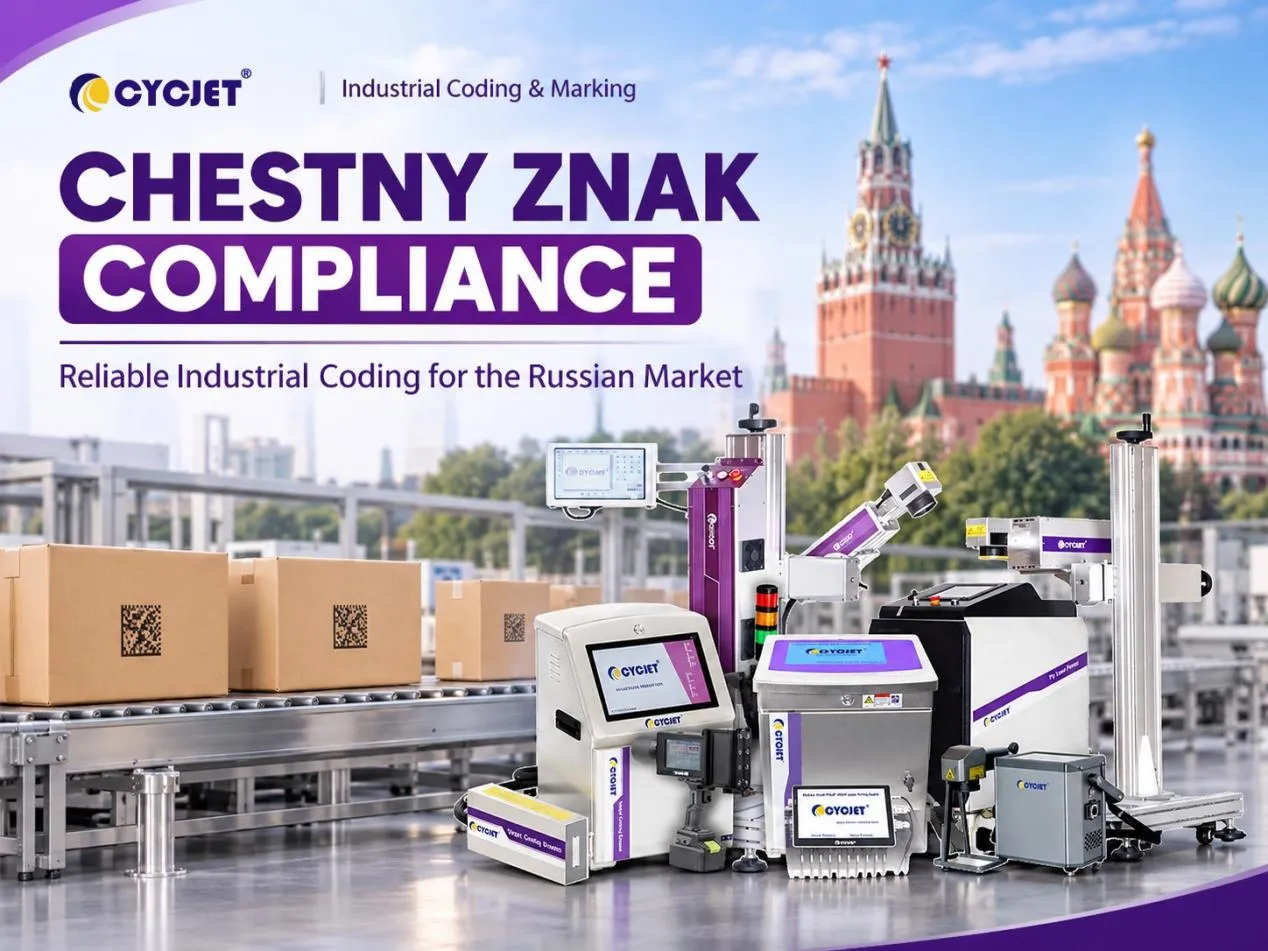
CYCJET (Shanghai Yuchang Industrial Co., Ltd.) specializes in industrial inkjet coding, laser marking, and automated identification solutions. The company provides comprehensive support for production-line marking and automation, tailored to the specific packaging requirements and production processes of each enterprise.
I. What is the Russian "Honest Mark" (Честный ЗНАК)?
"Chestny ZNAK" (Russian: Честный ЗНАК)—often translated as "Honest Mark"—is a national-level digital product identification and traceability system implemented in Russia.
The system is developed and operated by the Center for Research in Perspective Technologies (CRPT), the designated operator of Russia’s product identification framework. It is designed to manage information across the entire product lifecycle—from production, importation, warehousing, and distribution to the final retail stage—using digital coding.
Russia began a phased rollout of this mandatory product identification system around 2019. It currently covers a wide range of product categories, with its scope continuing to expand.
At the core of the system is the assignment of a unique digital identifier to each qualifying product, typically encoded via a Data Matrix 2D barcode. This coding framework allows regulatory authorities, distributors, retailers, and consumers to access product identification data through the system.
It is important to note that "Chestny ZNAK" is not merely a standard anti-counterfeiting QR code; rather, it is a comprehensive digital ecosystem encompassing product identification, regulatory data management, and the tracking of goods throughout the supply chain.

II. Why is Russia implementing a "trust label" (integrity labeling) system?
Russia has established a trust label system primarily to strengthen the regulation of commodity markets, enhance supply chain transparency, and reduce the presence of counterfeit, substandard, and illicitly circulated goods.
1. Combating counterfeit and substandard goods
By assigning a unique identification code to each product, regulatory authorities can verify the legitimacy and usage status of these codes, allowing them to detect anomalous repeated use or other instances of non-compliance.
2. Enhancing transparency in product circulation
Under the applicable regulatory framework, once a product enters the market—whether through domestic production or importation—information regarding its circulation and operational status can be recorded, facilitating effective oversight and traceability.
3. Protecting Consumer Rights
Consumers can use an official application to scan the Data Matrix code on a product, allowing them to access relevant product information and the status of its identification, thereby gaining a better understanding of the product's origin.
4. Promoting Digital Management for Businesses
For manufacturers, importers, and distributors, product identification data can be integrated with warehousing, order management, logistics, and ERP systems, providing data support for inventory management, product tracking, and supply chain coordination.
Consequently, these "integrity labels" serve not only as an anti-counterfeiting measure but also as a catalyst for the transition of Russia’s product distribution system toward greater digitalization and transparency.
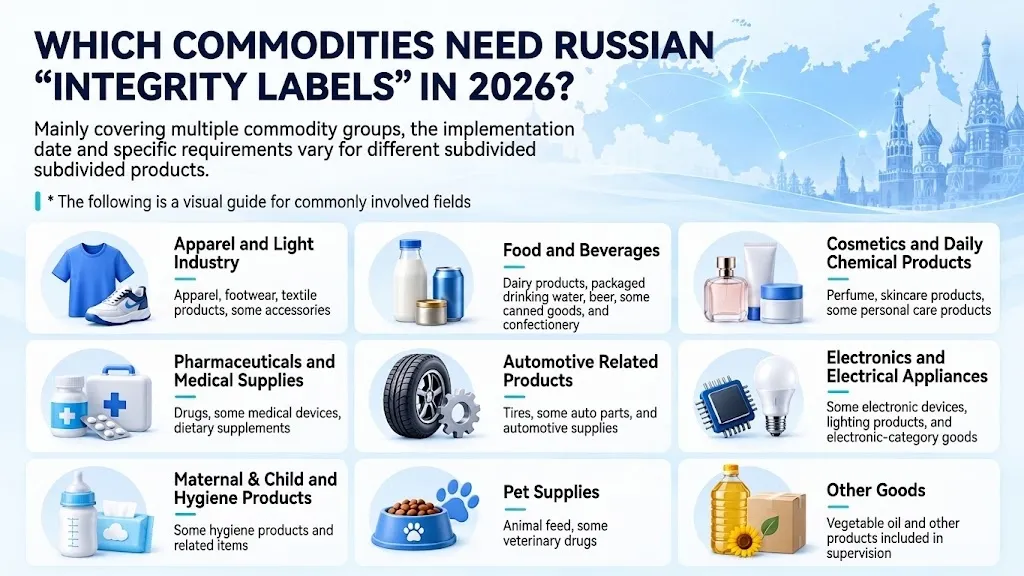
III. Which products will require Russian "integrity labels" (mandatory labeling) by 2026?
As Russia’s mandatory product labeling system continues to expand, the scope of these "integrity labels" now encompasses over twenty product categories. Implementation timelines, registration requirements, and specific labeling rules vary by product category.
The system primarily covers the following areas:
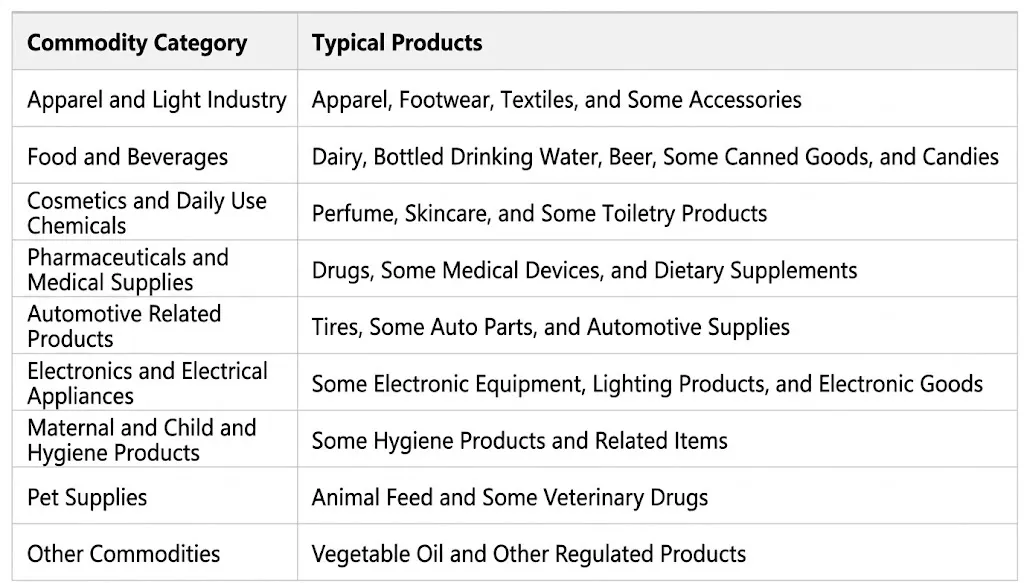
Russia typically implements these requirements in phases, categorized by product type, customs code, effective date, and the specific stage of the supply chain (e.g., import, inventory management, or retail sale).
For instance, while a certain category of goods may already be subject to mandatory registration, requirements concerning the labeling of imports, the handling of existing inventory, or retail settlement procedures may still be in various transitional stages.
Therefore, before arranging production and exports, Chinese enterprises should verify the specific requirements applicable to their products by consulting the relevant Russian customs codes (HS codes/TN VED EAEU), product classifications, and associated regulations.
IV. What type of encoding is used for Russian "integrity labels" (product identification labels), and how do they differ from standard QR codes?
The Russian product identification system primarily utilizes Data Matrix 2D barcodes as the medium for product identification.
Although both Data Matrix codes and standard QR codes are types of 2D barcodes, they differ significantly in terms of data structure, encoding rules, and application scenarios.
1. Data Matrix serves as the primary medium for product identification.
A typical Russian product identification code may contain the following information:
Product identification data, such as a GTIN (Global Trade Item Number);
A unique serial number for the individual item;
Verification information or encrypted validation data, configured according to the requirements for the specific product category.
The GTIN is used to identify the product category or specific trade item, while the serial number is used to distinguish individual units within the same product category.
In this way, even products from the same batch or of the same model can each possess a unique, independent digital identity.
2. Standard QR codes cannot serve as direct substitutes for integrity labeling codes.
Enterprises cannot simply use standard product QR codes in place of the identification codes required by the official Russian system.
Compliant codes must adhere to the specific coding structure, data format, and validation rules applicable to the relevant product category. In cases where identification codes contain encrypted verification data, it is also necessary to correctly handle special characters, field delimiters, and other associated data.
3. Print quality directly affects scan readability
Even if the encoded data is entirely correct, issues such as blurring, missing elements, distortion, reflections, or insufficient contrast during the printing process can prevent industrial scanning equipment from reading the codes reliably.
Particularly in high-speed production environments, ensuring the clarity, integrity, and consistent positioning of Data Matrix codes is a critical challenge that enterprises must address when implementing product labeling for traceability.
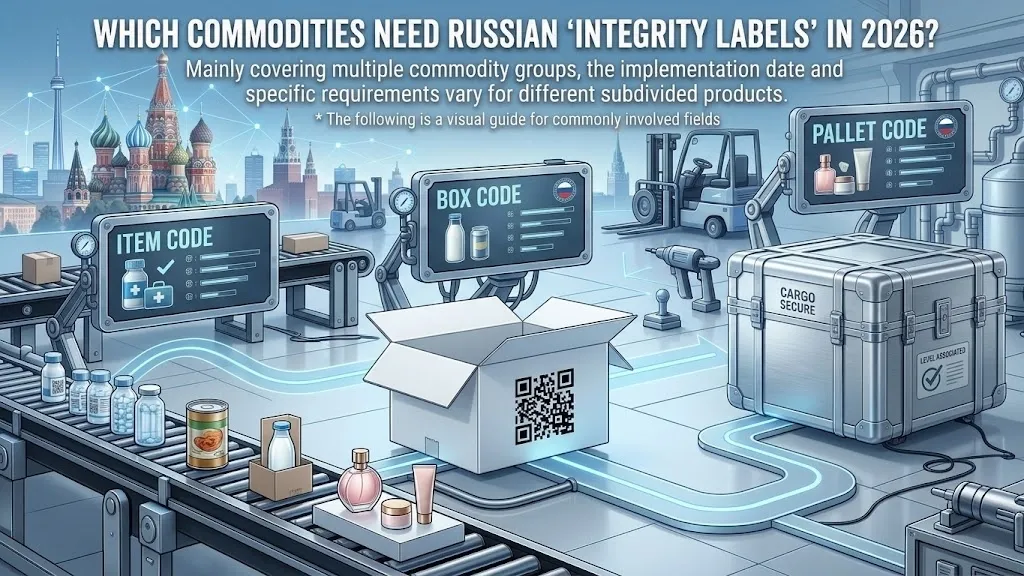
V. What is the association between item-level codes, carton codes, and pallet codes?
For Chinese manufacturers exporting to Russia, applying codes to products is just one step in the overall process.
When a company packs a large number of individual items into cartons, and then consolidates multiple cartons onto a pallet for transport, it involves linking different levels of packaging—a process known as "aggregation."
For example, consider a Chinese cosmetics factory that produces 10,000 bottles of skincare products, each labeled with a unique Data Matrix code. The company packs 100 bottles into a single carton, resulting in a total of 100 cartons.
Through a data collection and association system, the following hierarchy can be established:
Item-level code → Carton code → Pallet code
Each carton code is linked to the specific item-level codes of the products contained within it, while each pallet code is linked to the information of the cartons loaded onto that pallet.
With the appropriate system and operational workflows in place, warehouse or logistics personnel can simply scan the label on the outer packaging to retrieve data on the items inside, thereby eliminating the need to scan each individual product.
It should be noted, however, that this hierarchical association is not a universal requirement for all product types or scenarios. The specific approach must be determined based on the regulations applicable to the relevant product category in Russia, as well as the specific requirements of the importer.
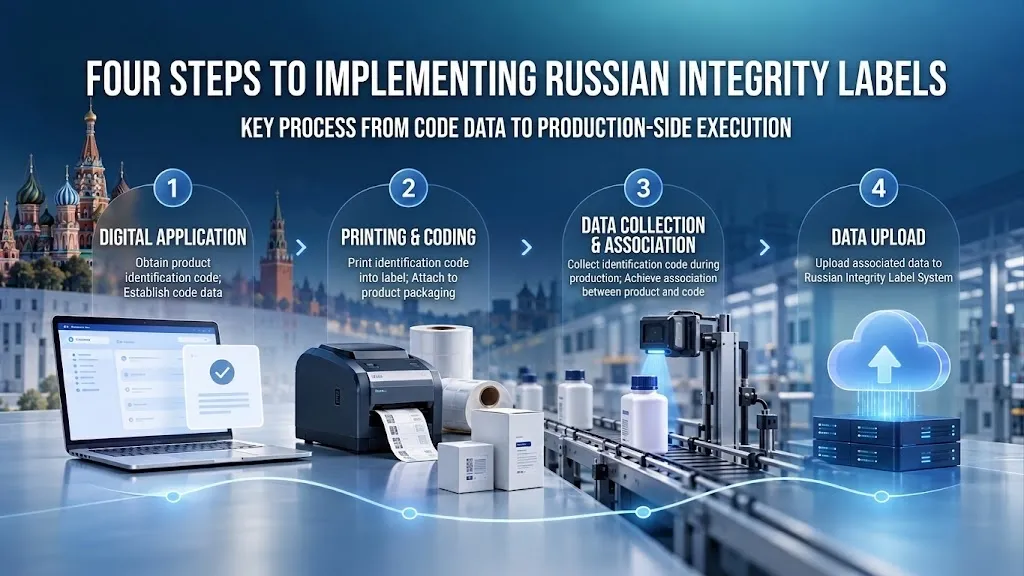
VI. How to Apply for and Implement the "Integrity Label" for Chinese Exports to Russia?
For Chinese manufacturing enterprises, the implementation of the Russian "Integrity Label" (track-and-trace system) typically involves product registration, code application, label printing, and data management.
Step 1: Determine Regulatory Scope
First, identify the category of the exported goods, their customs (HS) codes, and the relevant implementation dates to determine whether product registration, the application for identification codes, packaging association, and data declaration are required.
Step 2: Register Product Information
Registration on the platform, entry of product details, and management of product codes are generally handled by the importer—or another designated responsible entity—that meets the requirements of the Russian system. The specific responsible party is determined based on the product category and the import model.
Step 3: Apply for Integrity Labels (Identification Codes)
The responsible entity applies for the necessary product identification codes through the Russian integrity labeling system and then provides the required code data to the Chinese manufacturing plant or relevant service provider, in accordance with actual production schedules.
Step 4: Process Data and Apply Labels
Upon receiving the code data, the Chinese factory must process it to meet the "Data Matrix" encoding requirements and select appropriate labeling equipment, taking into account the product's packaging and specific production processes.
Common methods include:
Industrial inkjet coders: Suitable for in-line printing of information such as production dates, batch numbers, and Data Matrix codes.
UV inkjet printer: Suitable for high-precision marking on surfaces made of plastic, composite materials, and certain specialized packaging.
Laser marking machines: Suitable for creating permanent marks on various types of paper-based packaging, plastics, and metal products.
Label printing and labeling systems: Suitable for products that require identification codes to be applied via labels.
Once printing is complete, the readability and consistency of the identification codes should be verified using scanning equipment or an industrial vision system.
For production projects requiring the association of different packaging levels, systems such as in-line scanners, industrial cameras, handheld terminals (PDAs), or automated data collection solutions can be configured to establish data linkages between individual product codes, case codes, and pallet codes.
VII. How Does CYCJET Help Chinese Factories Implement "Chestny Znak" (Integrity Label) Marking for Russia?
For Chinese manufacturing enterprises exporting to Russia, a key challenge in implementing the "Chestny Znak" (Integrity Label) system is how to effectively integrate Russia’s digital identification requirements into existing domestic production processes.
CYCJET (Shanghai Yuchang Industrial Co., Ltd.) specializes in industrial coding and marking technology. Its product portfolio includes small-character inkjet printers, UV inkjet printers, high-resolution inkjet printers, DOD (Drop-on-Demand) large-character inkjet printers, as well as fiber, CO₂, and UV laser marking systems. The company also provides customized automated marking solutions tailored to specific project requirements.
Regarding the application of "Chestny Znak" labels within the production environment, CYCJET offers support in the following areas:
1. Online Data Matrix Coding
For manufacturing enterprises that need to print Data Matrix codes directly onto the surface of products or packaging, CYCJET offers a range of industrial coding solutions tailored to specific requirements—such as packaging material, content to be printed, production speed, and available installation space.
Examples include:
CYCJET Continuous Inkjet (CIJ) Printers: Ideal for bottled products, plastic packaging, and other high-speed, continuous production environments.
CYCJET UV Inkjet Printers: Designed for plastics, composite materials, and other surfaces that demand high printing precision and strong adhesion.
CYCJET High-Resolution Inkjet Printers: Suited for printing high-resolution codes on cartons, boxes, and various other packaging surfaces.
CYCJET Laser Marking Systems: Perfect for products or packaging compatible with laser processing, providing durable, permanent markings.
Enterprises can select the most appropriate equipment based on their specific packaging materials and the required code dimensions, ensuring that the coding needs of various production lines are effectively met.
2. Automated Coding for High-Speed Production Lines
For manufacturers of food, beverages, cosmetics, and consumer goods, manual printing or labeling of individual items is often constrained by production speeds and human operational factors.
CYCJET offers integrated in-line coding and automated marking solutions—tailored to your existing conveyor systems, product positioning methods, and specific printing requirements—to enable seamless information printing while products move along the production line.
By strategically configuring printhead placement, conveyor systems, and coding trigger mechanisms, you can significantly enhance both the efficiency and stability of the coding process.
3. Identification Code Quality Inspection
Beyond ensuring that Data Matrix codes are generated correctly, it is essential to verify that they remain readable by scanning equipment after being printed.
For projects with stringent quality management requirements, industrial scanners or machine vision inspection systems can be integrated to evaluate the printed codes, enabling the prompt detection of issues such as missing prints, defects, blurriness, or other anomalies.
4. Packaging Data Acquisition and Automated Association
For projects requiring data linkage across individual items, cartons, and pallets, CYCJET offers solutions—including in-line scanning, data acquisition, and packaging association equipment—tailored to the client’s automation needs.
By scanning codes on both the products and their outer packaging, and integrating these with a corresponding data management system, it is possible to establish precise relationships between different levels of packaging, providing a robust data foundation for downstream warehousing and logistics management.
5. Customized Solutions Based on Actual Production Conditions
Packaging materials, product specifications, production speeds, and marking locations vary from one factory to another; therefore, a single piece of equipment may not be suitable for every scenario.
Based on product samples, packaging materials, production line speeds, and marking requirements provided by the client, CYCJET can assist with equipment selection and conduct printing tests. This helps enterprises determine the marking solution best suited to their specific production environment.
It should be noted that the registration of products, application for official codes, and submission of statutory data to the Russian "Chestny Znak" (Integrity Label) platform must be handled by the responsible entity in compliance with local regulations. CYCJET primarily provides industrial marking equipment for the production stage, along with relevant automation support; the specific scope of data interfacing and system integration will be determined based on project requirements.
Conclusion
The ongoing implementation of Russia’s product labeling and traceability system places higher demands on Chinese exporters regarding the quality of product marking, production management, and data traceability.
For manufacturers, proactively identifying the applicable regulations, selecting the appropriate coding method, and ensuring the quality of the codes applied during the production process are essential steps for successfully conducting business in the Russian market.
CYCJET (Shanghai Yuchang Industrial Co., Ltd.) remains committed to providing tailored coding solutions—encompassing industrial inkjet printing, laser marking, and automated identification technologies—to meet the specific production requirements of clients across various industries. By enhancing the efficiency of production marking, we provide reliable technical support to help enterprises successfully bring their products into international markets.
Contact Person: David Guo
Telephone: +86-21-59970419 ext 8008
MOB:+86-139 1763 1707
Email: sales@cycjet.com
Web: https://cycjet.com/
Keywords:
Russian Integrity Label
Chestny ZNAK
Russian Product Identification
Mandatory Product Identification in Russia
Data Matrix QR Code
Industrial Coding/Marking Machine
CYCJET Coding and Marking Solutions

WeChat QR code


