


Welcome to Cycjet. Professional manufacturer of intelligent inkjet coding and laser marking machines
On November 1, 2026, Announcement No. 1049 of the Ministry of Agriculture and Rural Affairs—*Requirements for the Format and Generation of QR Codes on Pesticide Labels*—will officially come into effect. These new regulations establish clear standards for the encoding, content, and traceability of QR codes on pesticide products, driving a shift toward the digitalization and standardization of pesticide packaging and labeling.
For pesticide manufacturers, this entails more than just adding a QR code to their packaging; it requires the refinement of existing production-line coding processes. Every stage—from QR code generation and in-line printing to the integration of backend data—must be seamlessly and accurately connected.
So, how should enterprises respond? And what role can coding and marking equipment play in this process?
I. What requirements do the new regulations on pesticide QR codes impose on manufacturing enterprises?
Under the new regulations, QR codes or Data Matrix (DM) codes may be used on pesticide labels; these must primarily consist of a traceability URL and a unique unit identification code. Companies should pay particular attention to the following requirements:
·Uniqueness: Each code must correspond to a single sales unit of the pesticide—ensuring a "one item, one code" system.
·Coding Standards: The unit identification code must consist of at least 32 Arabic numerals, generated in accordance with prescribed coding rules.
·Information Completeness: Scanning the code must allow for the retrieval of relevant information, such as the pesticide name and the registration certificate holder.
·Traceability Accuracy: Details including the production date, production batch, and quality inspection results must be accessible via the traceability URL and must match the information actually marked on the product.
Consequently, traditional methods of printing static, fixed content are no longer sufficient to meet the labeling requirements for all pesticide packaging. Companies must now possess the capabilities for dynamic QR code generation, data transmission, and in-line printing.
II. Where Do the Real Challenges Lie in Coding Pesticide Packaging?
Printing a QR code itself is not particularly complex; the true challenge lies in ensuring that the QR code on each individual package is accurate, unique, and correctly linked to the corresponding traceability data in the backend system.
1. Dynamic Coding: Preventing Duplicates and Errors
Every individual sales unit requires a unique QR code. During the production process, the coding system must continuously generate or assign distinct codes and transmit this data accurately to the printing equipment, ensuring that no codes are duplicated, omitted, or printed incorrectly.
2. Print Quality and Scanability
Pesticide packaging utilizes a variety of materials, such as plastic bottles and composite film pouches. Factors including the surface characteristics of the packaging, production line speed, and ink adhesion all influence the final quality of the printed QR code. Any blurring, missing elements, or distortion can hinder subsequent scanning.
3. Coding equipment must work in tandem with a traceability system.
While a coding machine is responsible for printing QR codes onto packaging, it does not handle the full scope of code management. Enterprises must effectively integrate their coding systems, production management systems, and in-line inspection equipment to ensure that the printed content remains consistent with the data in the backend system.
Therefore, when selecting coding equipment, one should consider not only its QR code printing capability but also its capacity for dynamic data transmission, production line integration, and operational stability during continuous use.
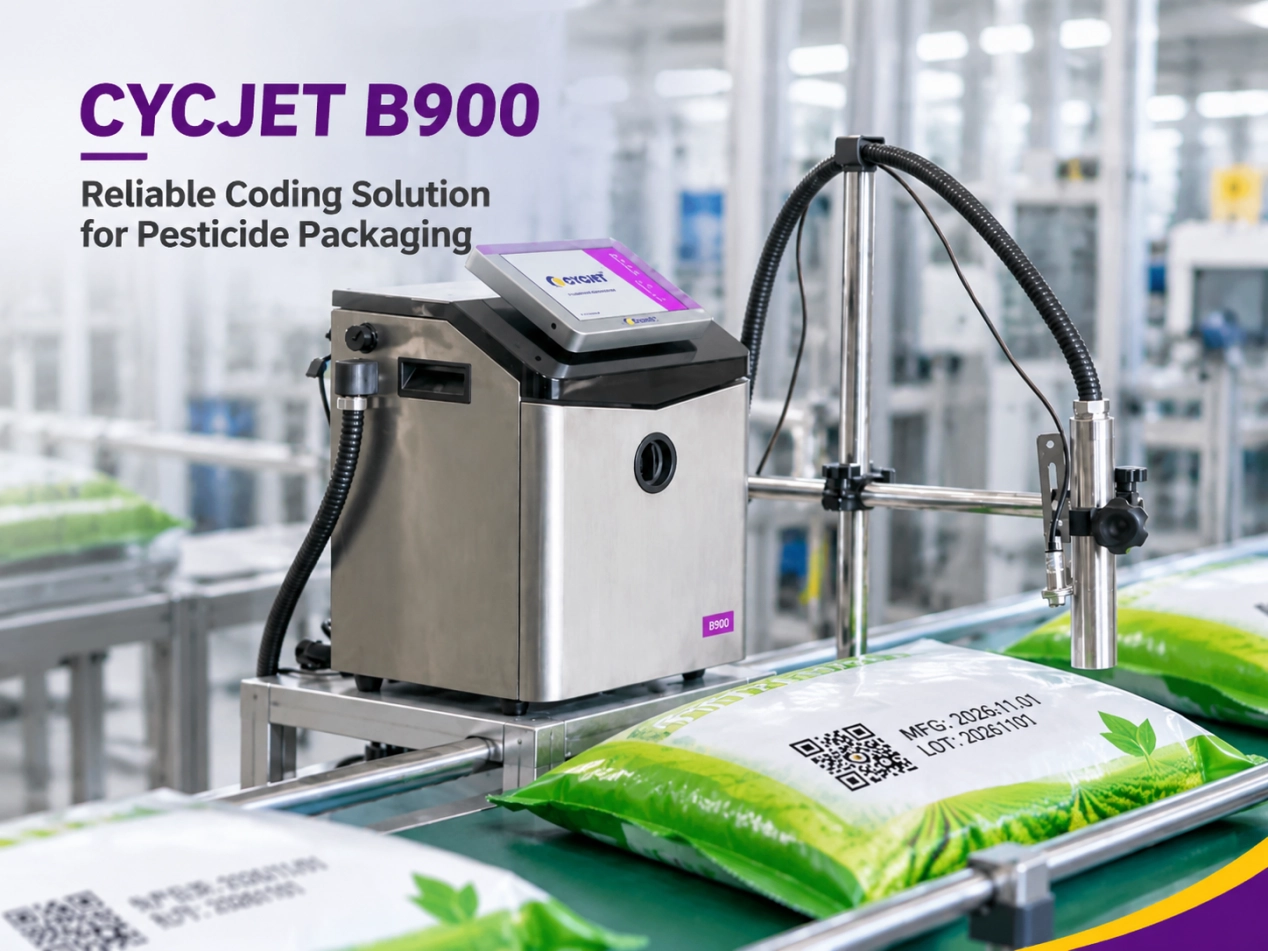
III. CYCJET B900 Small Character Inkjet Printer: Meeting Online Coding Requirements for Pesticide Packaging
Designed to address the packaging identification needs of pesticide manufacturers, the CYCJET B900 small-character inkjet printer utilizes Continuous Inkjet (CIJ) technology. It enables non-contact printing on a wide range of compatible packaging materials and is well-suited for integration into continuous packaging production lines.
Support for QR Codes and Dynamic Data Printing
The B900 supports 2D codes—such as QR codes and Data Matrix—as well as production dates, batch numbers, and various 1D barcodes. When paired with an external coding system, it can receive dynamic QR code data, facilitating the "one item, one code" (unique identifier) requirement for online printing.
High-Speed Printing for Continuous Production
The system achieves a maximum printing speed of 380 meters per minute, with a print height ranging from 1.5 mm to 15 mm and support for up to 4 lines of content. Enterprises can combine elements—such as QR codes, production dates, and batch information—to suit their specific packaging layouts.
Stable Operation to Minimize Production Downtime
Equipped with a dual-detection system—featuring both "time-of-flight" and physical viscosity monitoring—the B900 tracks ink status in real time. This ensures consistent print quality, making it ideal for long-duration, continuous production runs.
Seamless Production Line Integration
The unit includes Ethernet, RS-232, and USB interfaces, allowing for integration with existing coding systems and production line equipment. This facilitates dynamic data transmission and enables efficient, in-line printing.
IV. How to Establish a Comprehensive QR Code Marking Process for Pesticides?
For pesticide manufacturers, simply upgrading coding equipment is insufficient. It is advisable to plan the entire production process:
1. QR Code Generation: Use a coding system to generate unique codes that comply with new regulatory requirements.
2. Data Transmission: Transmit the QR codes and relevant production information to the coding equipment.
3. In-line Printing: Use the CYCJET B900 inkjet printer to print QR codes, production dates, and batch information onto the packaging.
4. Quality Inspection: Implement in-line code scanning or vision inspection systems to verify the integrity and readability of the QR codes.
5. Data Traceability: Link the actual marking records with product production and quality data to facilitate future inquiries.
By integrating these steps, enterprises can progressively establish a more standardized process for packaging-based marking and traceability.
Conclusion
The implementation of new regulations regarding QR codes for pesticides imposes requirements that go beyond simple printing; it serves as a rigorous test of a company’s production-line coding capabilities and information traceability systems.
The CYCJET B900 CIJ inkjet printer supports the printing of QR codes, Data Matrix codes, production dates, batch numbers, and other essential data. When integrated with a coding system, it provides pesticide manufacturers with an effective, in-line QR code marking solution.
If you are planning an upgrade to your pesticide packaging coding process, please contact CYCJET. Based on your specific packaging materials, QR code specifications, and production line speeds, we can recommend the ideal coding equipment and automated marking solutions for your needs.
Contact Person: David Guo
Telephone: +86-21-59970419 ext 8008
MOB:+86-139 1763 1707
Email: sales@cycjet.com
Web: https://cycjet.com/
Keywords:
Pesticide QR Code Regulations
Pesticide QR Code Printing
CIJ Inkjet Printer
Pesticide Packaging Coding

WeChat QR code


